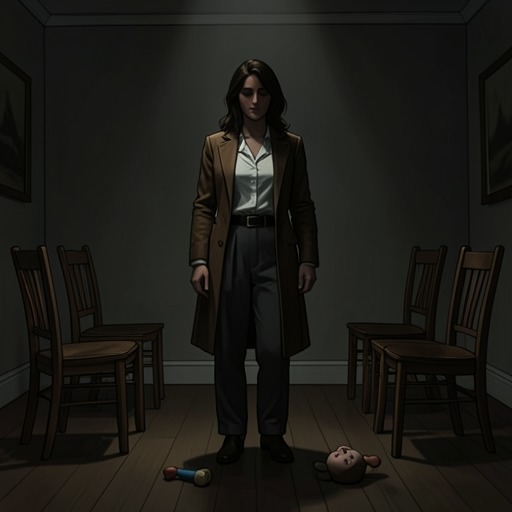
Ed
The Woman in the WindowEd, Anna Fox’s husband and Olivia’s father, remains a defining presence in Anna’s life even when he is elsewhere: on the telephone, in the routines of family memory, and, after his death, in the voices she continues to hear. Their marriage is already breaking apart before the crash that kills Ed and Olivia, but its intimacy survives in small exchanges—a child’s name for her parents, a shared call-and-response, a birthday chorus—and in Anna’s unresolved grief.
Identity and Family Life
Ed is Olivia’s father and Anna’s husband, though by the time Anna tells another person about him, she describes them as no longer together. His role as a parent appears in the family’s language as much as in any formal description. Olivia calls him Daddy, a title Anna contrasts with her own place as Mommy when she tries to manage their daughter’s eating. Ed advises Anna to let the matter go; Olivia then suggests that Anna come say hello. The exchange places him within an ordinary parental negotiation, not simply as a distant figure in Anna’s later recollections.
A second domestic detail gives the family separation a sharper edge. Looking out at the neighbors’ pumpkins, Anna tells Olivia that she wishes she could choose one for her, then asks her to tell her father to get two: one for Olivia and one for Anna. The request imagines a small act of family participation that Anna cannot carry out herself. Ed is still addressed as Olivia’s father, and Anna still imagines herself included in the household ritual, even as she watches from upstairs with wine in hand.
Marriage and Separation
The separation is a decision Ed initiates. Anna says that they had decided to separate ten days earlier, then corrects her own account: Ed had decided, and she had agreed in principle. She had not believed the decision would become real, even after he summoned a broker. Her correction matters. The separation is not presented as a mutual resolution reached on equal terms; Anna’s agreement coexists with disbelief that their marriage is actually ending.
When asked whether she has family who could be contacted, Anna looks at her wedding ring and says that her husband and she are not together anymore. The ring remains visible while she gives the answer, a concrete sign of the gap between the continuing legal or symbolic bond and the separation she must now explain. Ed is not simply absent from her list of possible support: the question makes clear that Anna no longer treats him as someone available to call in a crisis.
The breakup also has a concealed history. Anna recalls four months of lies, including lies to Ed, who discovered the truth when she sent him a text intended for someone else. The passage establishes that the marriage had been damaged by Anna’s secret relationship, but does not identify the recipient of that text in the excerpt. It makes the separation more complicated than a single decision: Ed’s discovery is part of the history Anna carries into the night of the crash, and her recollection is marked by regret for the relationship that preceded it.
Contact, Affection, and Practical Concern
Distance does not erase the couple’s familiar manner with one another. In one call, Ed opens with their recurring exchange, “Guess who,” and Anna answers that it is her line. He calls her “slugger,” a teasing endearment that recurs when he checks how she is doing. The playful ritual briefly restores a shared language even as their relationship is changing. It also becomes an especially charged pattern later, when Anna hears the phrase in the voices of the dead.
Their phone conversations hold tenderness as well as banter. Anna tells Ed, “I miss your heart,” and he replies, “I miss you so much.” The exchange is direct but not a reconciliation: the evidence records mutual longing without reversing the separation. That distinction gives the affection its particular force. Ed and Anna can still speak with intimacy, while the decision that has divided them remains in place.
Ed also offers practical advice when Anna worries about David, her tenant. He tells her that if she is concerned, she should contact the police—not because David is necessarily involved, but because he has a record and she should not be afraid in her own home. His warning is measured rather than accusatory: he explicitly leaves David’s involvement uncertain while urging Anna to seek help. The advice shows Ed acting as a concerned confidant from a distance, even though Anna has already said that they are no longer together.
That caution is especially visible after Anna tells him about the apparent attack on her neighbor. Ed asks whether she is sure it was the husband who did it. He does not endorse Anna’s conclusion as established fact; instead, he tests the identity of the alleged attacker. His question introduces doubt into Anna’s account while still taking the reported violence seriously, a combination that contrasts with the certainty Anna often feels in the crisis.
Death and Continuing Presence
Anna’s account eventually places Ed among the people who have died. After the crash, she describes hearing the voices of lost people when their absence overwhelms her, when she needs someone to talk to, and when she least expects them. Ed is among those whose voices return with the familiar greeting, “Guess who.” She responds to them, and the voices can make her beam and feel that her heart is singing. The greeting that once belonged to an ordinary exchange with her husband becomes a form through which grief briefly restores contact.
That comfort is not constant or uncomplicated. When the voice says, “Guess who?” Anna shakes her head and does not want to talk to Ed at that moment. The repeated greeting therefore carries both connection and refusal: she may welcome the voices, but she is not always ready to answer. His posthumous presence is framed through Anna’s shifting needs rather than as a simple, permanent consolation.
The family survives in remembered gestures as well. On a later birthday, Ed and Olivia chorus, “Happy birthday,” while Anna rolls away in bed. The scene preserves them together as a family voice, but Anna’s movement away from the greeting registers her inability, at that moment, to meet the memory. The birthday scene and the recurring call-and-response make Ed’s absence audible: his voice continues in Anna’s mind, while the living relationship and household that once gave the voice its ordinary setting are gone.
Narrative Role
Ed is characterized less through extended scenes of independent action than through Anna’s recollections and their calls. This restricted presentation keeps him close to her emotional experience while leaving the marriage’s full history partly outside the account. The reader sees his decision to separate, Anna’s reluctant acceptance, the discovery of her secret through a misdirected text, and their continuing exchanges of care and affection; the evidence does not reduce their relationship to any one of these elements.
His role consequently shifts across the narrative: father in the pumpkin and parenting exchanges, estranged husband in Anna’s account of the separation, familiar companion in their teasing calls, and lost family member in the voices she hears after the crash. The same greeting can first signal recognition and play, then become a summons from memory. Ed’s significance lies in that continuity and reversal: even after Anna has acknowledged that they are apart, and after he is dead, the language they shared remains one of the ways she experiences attachment and loss.